
Navigating AI Transformation: Unlock Opportunities and Manage Risk
Discover how organizations can successfully navigate their AI transformation journey by identifying strategic opportunities while implementing robust risk management frameworks.
Artificial Intelligence (AI) is no longer a futuristic concept - it's embedded into the tools and platforms businesses use every day, from AI copilots assisting in software development to machine learning algorithms driving decision-making. For medium to large businesses, this means that the AI transformation journey has already begun, whether or not it has been formally recognized. However, as organizations adopt AI solutions at an accelerating pace, they must grapple with a key challenge: managing risk as they unlock benefits from AI investments.
Understanding and managing this relationship is critical for leaders tasked with steering their organizations through the complexities of AI adoption. Without a deliberate approach to assessing AI risks and growing organizational maturity, businesses may find themselves exposed to significant uncertainties while missing opportunities for strategic advantage.
The Dual Trajectory of AI Risk and Maturity
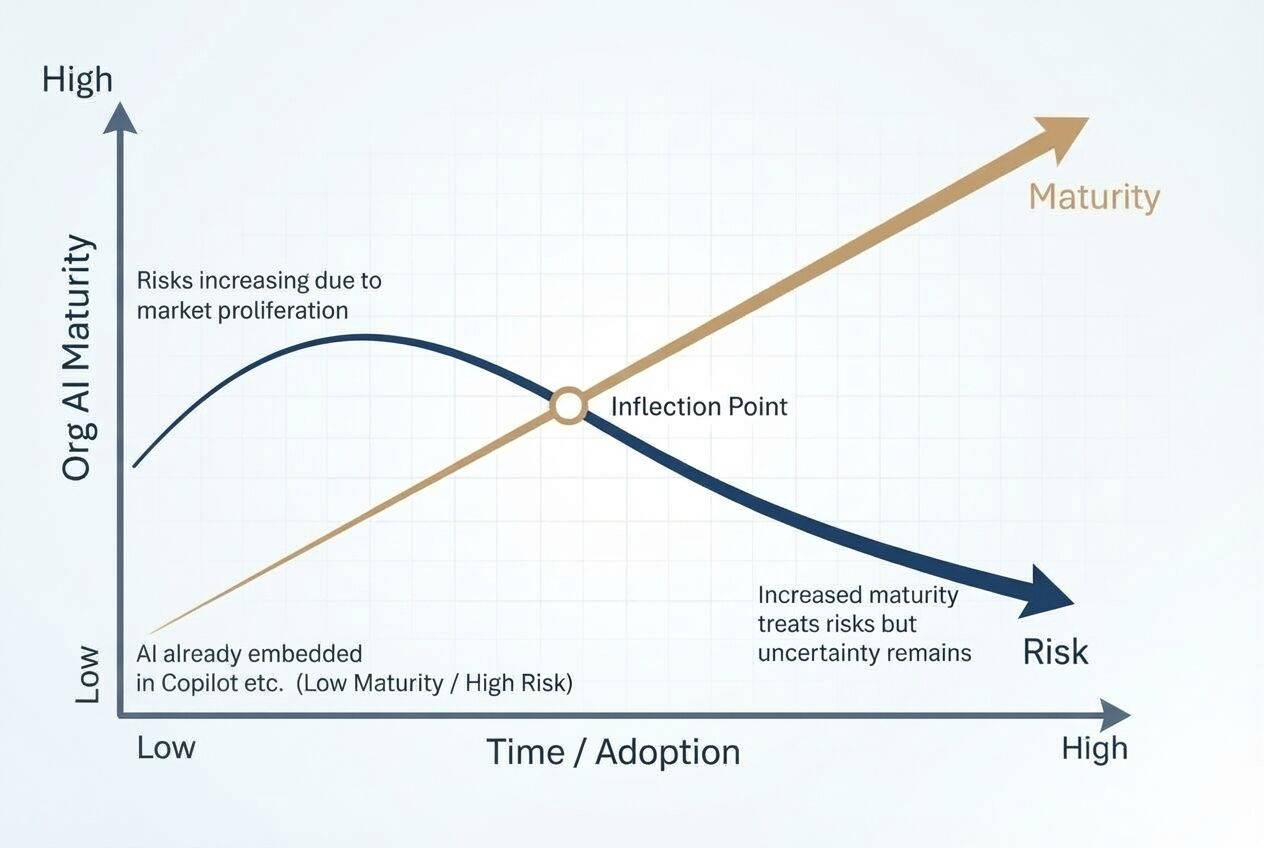
The relationship between AI risk and adoption maturity can be visualized as two intersecting trajectories.
1. The Rising Curve of AI Risk
In the early stages of AI adoption, risks often increase as organizations introduce AI-powered tools into their workflows. This is particularly true in today's environment of market proliferation, where AI solutions are becoming ubiquitous. Employees may embrace AI technologies like Copilot or other generative AI tools without fully understanding their implications, leading to risks such as data leakage, compliance violations, or unintended consequences of biased algorithms. At this stage, the organization's capacity to manage these risks is limited, as its AI maturity is still in its infancy.
2. The Maturity Risk Trade-off
As organizations invest in their AI maturity - by establishing governance frameworks, developing AI competencies, and aligning AI initiatives with business strategy - the ability to mitigate and manage risks improves. However, even with growing maturity, uncertainty does not disappear entirely. AI technologies remain inherently complex and rapidly evolving, posing ongoing challenges that require a proactive and adaptive approach.
The Hidden Risks of Ignoring AI Proliferation
For many organizations, AI adoption is already happening informally. Employees are integrating AI tools into their workflows independently, often without oversight or alignment with broader organizational policies. This phenomenon, sometimes referred to as "shadow AI," introduces risks that may go unnoticed until they lead to significant business consequences. For example:
- Data Security and Privacy: Tools like generative AI copilots may inadvertently expose sensitive company data if used without appropriate safeguards.
- Regulatory Compliance: AI tools may process data in ways that violate industry regulations, leaving the organization vulnerable to fines or reputational damage.
- Operational Misalignment: Without a centralized strategy, AI usage across teams may result in fragmented processes, inefficiencies, and missed opportunities for cross-functional value creation.
Why AI Maturity is the Key to Risk Mitigation
Achieving AI maturity doesn't mean eliminating risk entirely, but it does mean creating a structured and resilient foundation to address it. As your organization's AI maturity grows, you can implement measures to address challenges more systematically:
- Establishing Governance Frameworks: Create clear policies for AI tool usage, data handling, and ethical considerations.
- Upskilling Employees: Equip your workforce with the knowledge to use AI responsibly and effectively.
- Aligning AI Strategy with Business Goals: Ensure that AI initiatives are aligned with your organization's long-term objectives, maximizing value while minimizing risk.
- Adopting Continuous Monitoring: Regularly assess AI systems to identify and address risks as they evolve.
The Call to Action: Conducting an AI Risk and Maturity Assessment
For leaders of medium to large businesses, the question is no longer whether to adopt AI, but how to do so responsibly and strategically. The diagram above illustrates that as AI becomes more embedded in your organization, the risks will naturally rise unless actively managed. By increasing your organization's AI maturity, you can begin to reduce these risks and unlock the transformative potential of AI.
The first step in this journey is an AI risk and maturity assessment. This assessment provides a clear snapshot of where your organization currently stands in terms of AI adoption, the risks you face, and the maturity level required to address them. It helps you identify gaps, prioritize investments, and develop a roadmap for AI transformation that balances innovation with risk management.
Embrace the Opportunity, Manage the Risk
The AI revolution is here, and its impact on businesses is profound. By understanding the interplay between AI risk and maturity, leaders can take proactive steps to navigate this transformation with confidence. The organizations that succeed will be those that recognize the importance of assessing their current state, building maturity, and embedding AI into their strategies in a way that is both ambitious and responsible.
Are you ready to embark on your AI transformation journey? Start with an AI risk and maturity assessment - because the future of your business depends on it.
Ready to Assess Your AI Readiness?
Take our comprehensive assessment and receive a personalized roadmap for your AI transformation journey.